
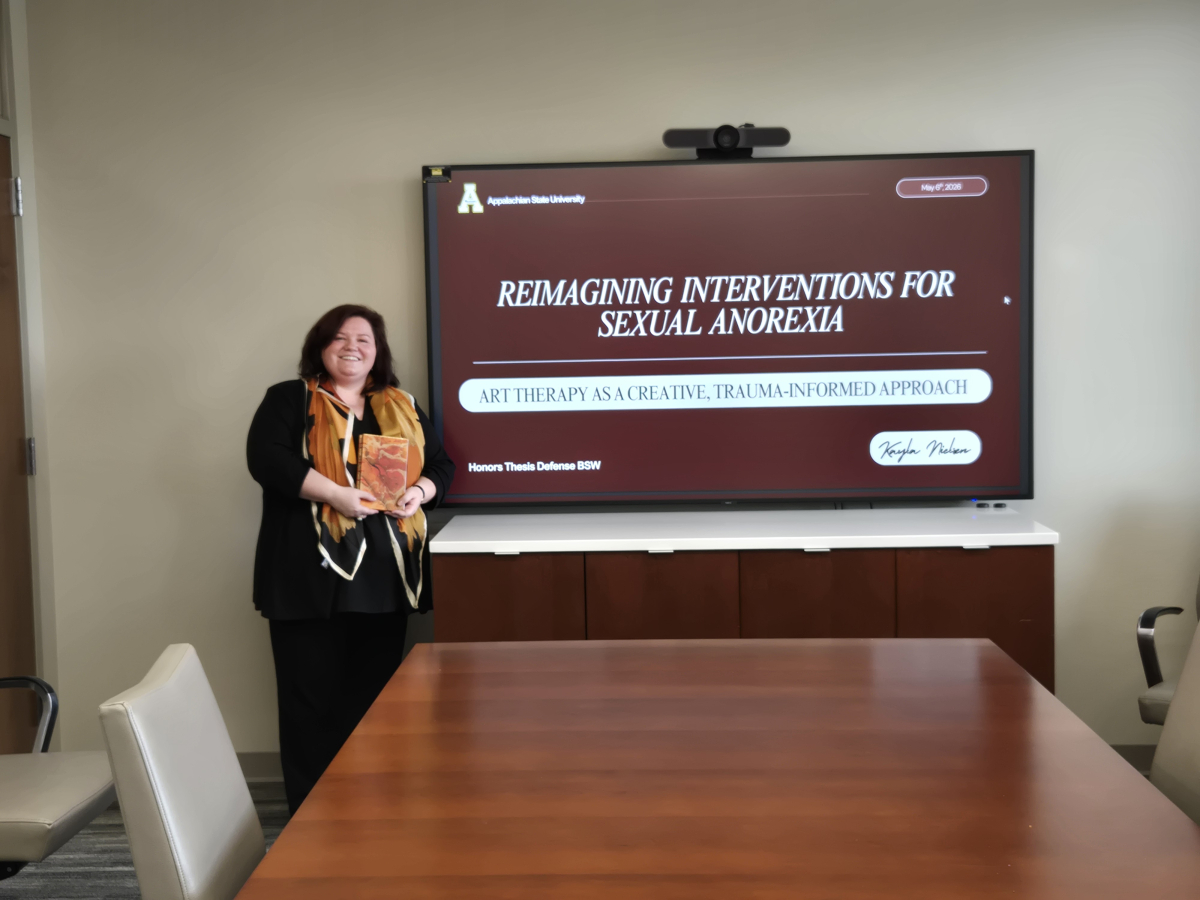
We are very happy to report that BSW student, Kayla Nielsen successfully defended her departmental honors thesis titled: Reimagining Interventions for Sexual Anorexia: Art Therapy as a Creative, Trauma-Informed Approach. Her thesis chair is Dr. Denise Levy, and her second reader is Dr. Ryan Papciak.
The abstract for her thesis is:
This literature review examines art therapy as an intervention for sexual anorexia, reframing the construct beyond traditional addiction models that position it as the inverse of compulsive sexual behavior (Carnes, 1997). While foundational, these models are increasingly limited; contemporary perspectives emphasize sexual anorexia as shaped by trauma, shame, attachment disruptions, and sociocultural context. For many, it reflects a protective response to perceived relational or emotional threat rather than an absence of desire for healthy intimacy (Freyd, 2008; Gottman, 2011; Platt & Freyd, 2015). The paper differentiates sexual anorexia from normative fluctuations in desire and situates it within trauma-informed and attachment-based frameworks, including how trauma can constrain creativity and play, reinforcing avoidant patterns (Malchiodi, 2020). This manuscript positions art therapy as a flexible, trauma-informed modality aligned with these integrative frameworks. Creative and sensory processes are shown to externalize shame, support embodied reconnection, and facilitate relational engagement beyond verbal processing (Rubin, 2010; Hass-Cohen & Findlay, 2015; Fosha, 2021; Huss, 2019). Clinical applications in both individual and group contexts are discussed, particularly their roles in relational repair, restoring playfulness, and increasing tolerance for vulnerability. The review concludes with recommendations for integrating art therapy into clinical practice, including considerations for assessment, differential diagnosis, and culturally responsive care. It also addresses limitations such as systemic barriers, cultural gaps, and challenges inherent in creative processes (Kramer, 1971; Anah, 2025), and outlines future research directions aimed at expanding definitions and interventions to reduce stigma and support more adaptive pathways to healing and connection.
Kayla's project helps to show the range of social work practice. It is very worthwhile for anyone who is interested in clinical social work practice especially, and as I learned in the defense, this topic overlaps with a number of other issues of significance in micro, mezzo, and macro social work practice.
Please join us in congratulating Kayla on her outstanding project on a very important and timely topic!